



Although she received a solid foundation for a teaching career after completing the Royal Art School, Paulina did not stop there. In 1937, the Academy of Fine Arts was founded in Belgrade, and this young painter belonged to the first generation of enrolled students. (24)
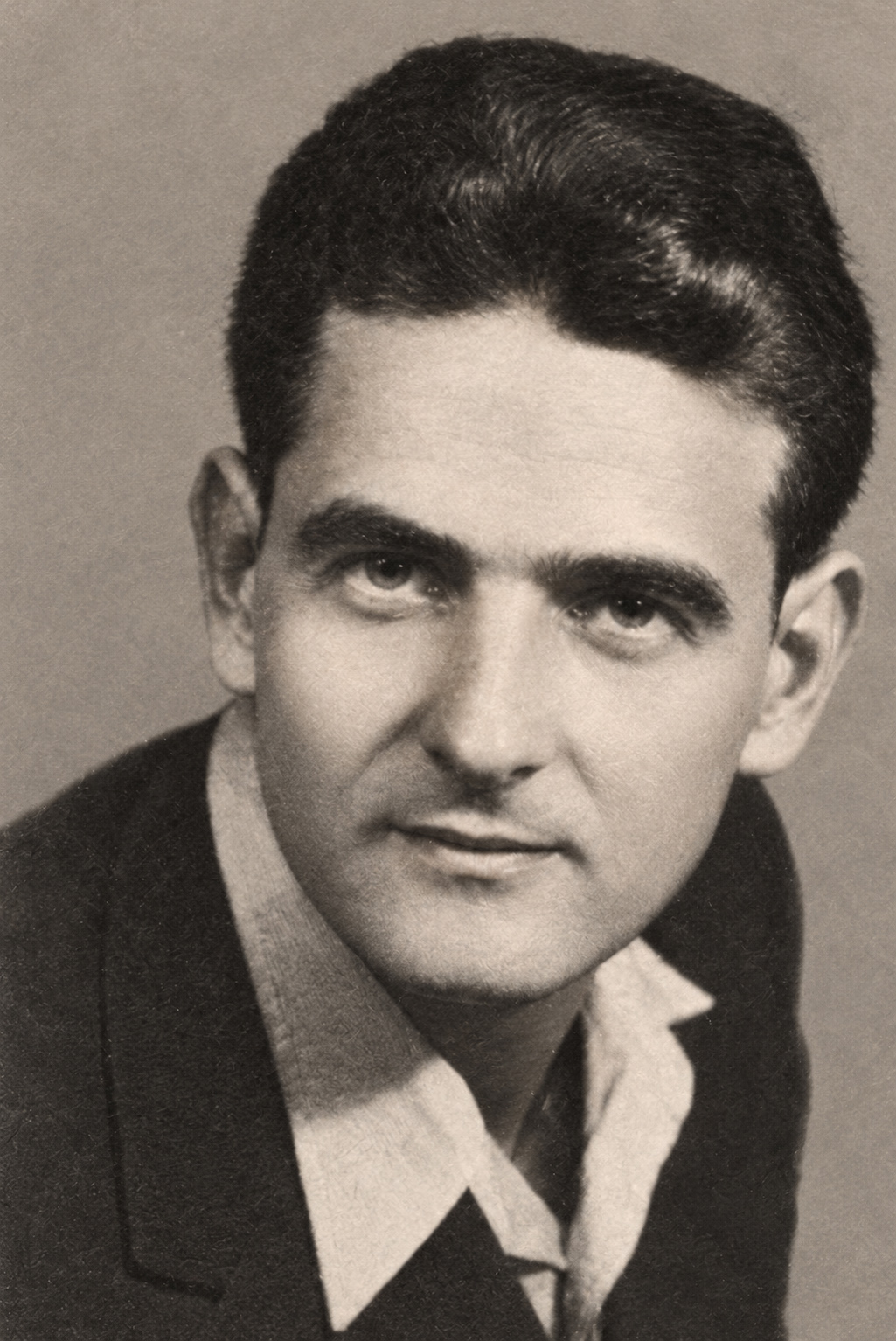
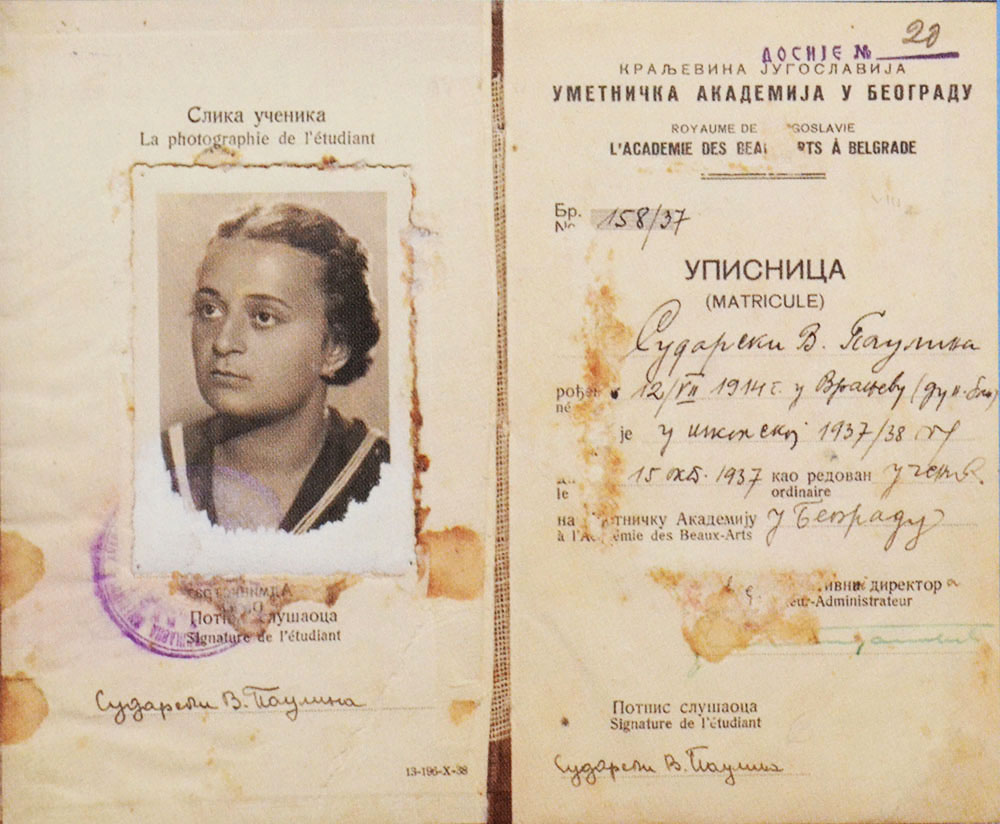 The founders and first professors of the Academy were Petar Dobrović, Milo Milunović, and Toma Rosandić, later joined by Sreten Stojanović and Jerolim Miše. All of them earned their degrees in one of the European art centers before establishing this higher education institution. Paulina Sudarski enrolled in the Academy for the academic year 1937/38 on October 15th, receiving index number 158/37. The last page contains records of exams passed and grades received in various subjects. Not all professors were unfamiliar to Paulina. Although not from the beginning, she would once again learn from Ljuba Ivanović at the Academy. The professor who had the most significant impact on her work, especially in nudes and portraits, and under whom she graduated, was Petar Dobrović. Anyone familiar with the work of this former student of the Pest Academy, already an accomplished painter at the time, would find analogies and obvious influence of the renowned professor on the young painter's work upon seeing a nude or portrait by Paulina Sudarski. We do not know if there were any earlier encounters between them. Before the establishment and commencement of work at the Academy, Petar Dobrović also engaged in pedagogical work at the Kolarčev People's University, where he led a course in figurative painting that unexpectedly gained significant popularity. (25) Interestingly, among the participants were only about ten young artists, while almost five times more were workers, lithographers, stonecutters, carpenters, tinsmiths, zincographers, and others. (26)
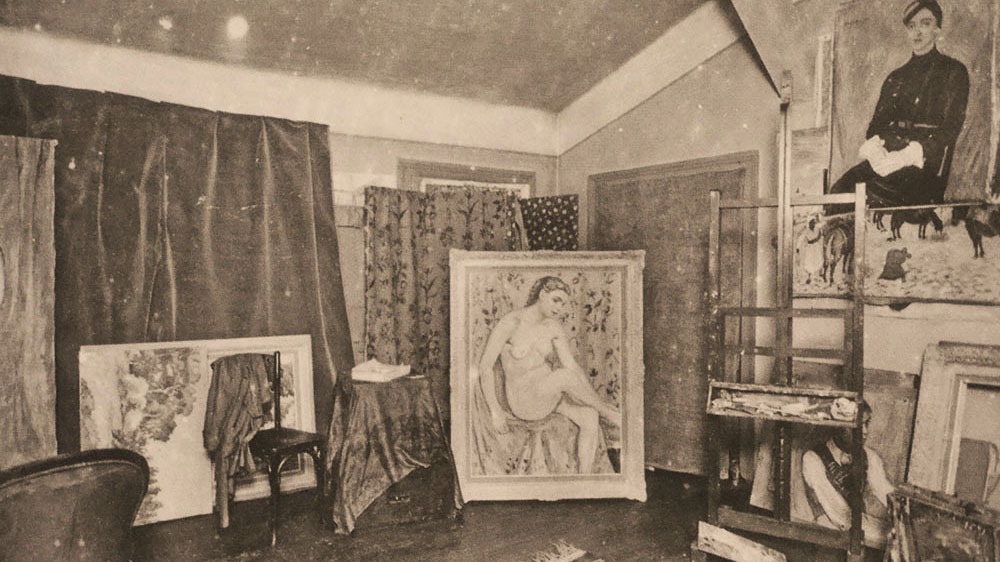
Paulina Sudarski was certainly not among them, officially meeting her professor at the Academy. Dobrović's cheerful decorativeness, particularly evident in his portraits and nudes, would become a characteristic feature of Paulina's works. Some critics even tend to see echoes of Matisse in them, perhaps most notably in the way Dobrović colored hands in red or pink, a trait also found in his student's work (Female Nude, NMZR, inv. no. 183), along with the distinctive black contour outlining the entire body of some of their nudes (Female Nude, NMZR, inv. no. 210). (27) Both Dobrović and Sudarski pay special attention to the background, which is equally vibrant. This decorative cheerfulness is embodied in red-blue curtains or floral draperies. (28)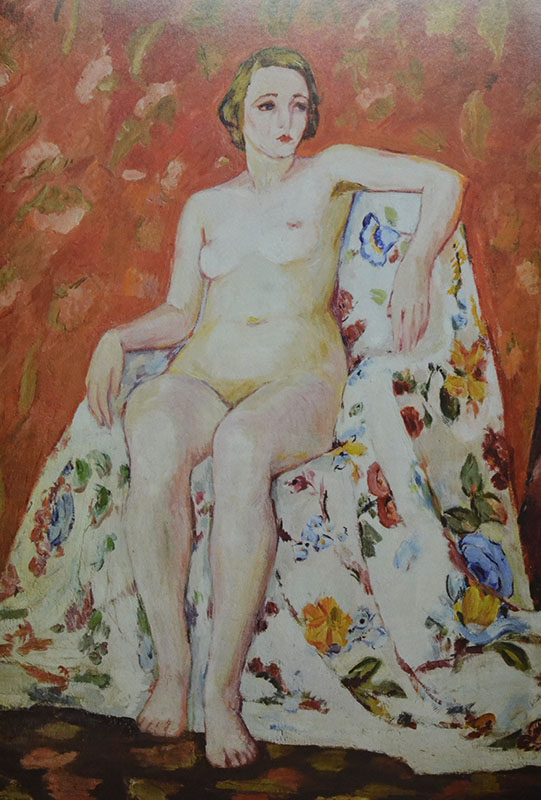 The Female Semi-Nude (NMZR, inv. no. 397) is particularly interesting, representing a female bust as a fragment of a whole seated nude (Female Nude, NMZR, inv. no. 181). The same model is recognized in Dobrović's famous Reclining Nude from 1939 (Museum of Contemporary Art Belgrade, reg. no. 537) (29), while in Paulina's work (Female Nude, NMZR, inv. no. 398), it resembles more of a study, an unfinished version of a nude. However, the decorative background remains, blue with large white and red flowers. Even the identical hand movement in the semi-nude and reclining nude. Almost as if we can imagine the professor and student side by side with easels next to the bed where a model with a proud gaze is stretched out. The fact is that most nudes were created based on models who posed for Dobrović in his studio. Based on a preserved photograph, we see what that studio looked like. We also recognize those famous floral draperies from some paintings, both Dobrović's and, of course, Paulina's. The statement by Marko Ristić that "he didn't want to finish a nude with a slipper until he got - a slipper" confirms that the professor created most nudes based on a model. And we see exactly such a slipper in Paulina's drawing (Female Nude, NMZR, inv. no. 318), reminiscent of the famous Nude from 1939/40 by her professor (Museum of Contemporary Art Belgrade, reg. no. 640), even though it is a painting, and the presence of clothing is only hinted at. The fact is, as seen in these examples, that both artists worked on multiple variations of one model, whether it was a seated or reclining nude, creating an intimate atmosphere with evident yet discreet seductiveness of the female body.
The next similarity is evident in works that were not created from a live model but where a sculpture served as the "model." In Dobrović's case, this is, for example, Sculpture on a Floral Background from 1940 (Museum of Contemporary Art Belgrade, reg. no. 683) (31), while in Sudarski's case, it is Torso 1 (NMZR, inv. no. 104) and Torso 2 (NMZR, inv. no. 207). The similarity here is even greater than in previous cases, and it has been determined that the sculpture in question is from ancient Greek art, "Aphrodite Squatting" (3rd century BCE) by Diodalses of Bithynia, originally in bronze, with a Roman copy in marble. (32) The whiteness of the marble seems to radiate even more against the lively decorative background.
However, not all of Paulina's nudes have that cheerfulness and sensuality. In some, characterized by a darker palette, the light is significantly dimmed, almost barely allowed onto the canvas. Even in such painted models, sensuality is not lacking, and Ciganica (NMZR, inv. no. 115) appears somewhat exotic, akin to Gauguin's Tahitian women, while the man who served as the model for Male Nude (NMZR, inv. no. 227), crossing his arms, gives the impression of a person patiently prepared for hours of posing.
A strong coloristic expressionism is present in all mentioned nudes by Paulina Sudarski, where color triumphs over form, emphasizing the vitality, sensuality, and sensuousness of the human body - a triumph of life that the young student eagerly anticipated.
For most nudes, Paulina created sketches, explaining the large number of drawings in her body of work. Unlike female painted nudes that celebrate the sensuality, harmony, and sensuousness of nudity, male figures are usually depicted as sturdy young men, athletic in build, as seen in the example of Male Nude (NMZR, inv. no. 317), where the author explains with her signature in the upper right corner that it is an evening nude. Here, too, Paulina relies on her professor, whose "figures stand firm and massive like sculptures, and their musculature, mighty and heroic, appears sculpted or cast." (33) Her thorough knowledge of anatomy, perspective, and a confident stroke is evident even in a highly linear type of drawing, almost a sketch (Male Nude, NMZR, inv. no. 495). (34)
24 In the student service of the current Faculty of Fine Arts, formerly the Academy of Fine Arts, dossier number 20 is found with the name Paulina Sudarski.
25 Žana Gvozdenović, Masterpieces of Petar Dobrović, Museum of Contemporary Art Belgrade, 2011.
26 Documentation on the creativity of Petar Dobrović III, edited by Olga Dobrović, Gallery of Matica srpska, Novi Sad, 2002.
27 Olivera Skoko, My Body-Your Work (exhibition catalog), National Museum Zrenjanin, 2011.
28 Same
29 The work is from the collection of the Gallery of Petar Dobrović located at Kralja Petra 36 Street, Belgrade.
30 Rajka Bošković, Poetization of Nudity, Nude in the Paintings of Petar Dobrović, Museum of Contemporary Art Belgrade, 2014, 34.
31 This work, like the previously mentioned one owned by MSUB, is from the collection of the Gallery of Petar Dobrović, Kralja Petra 36 Street, Belgrade.
32 Rajka Bošković, Poetization of Nudity, Nude in the Paintings of Petar Dobrović, Museum of Contemporary Art Belgrade, 2014, 57.
33 Todor Manojlović, Petar Dobrović, Thought, book.3, volume 2, Belgrade, 1920.
34 Olivera Skoko, My Body-Your Work (exhibition catalog), National Museum Zrenjanin, 2011.
Comments