



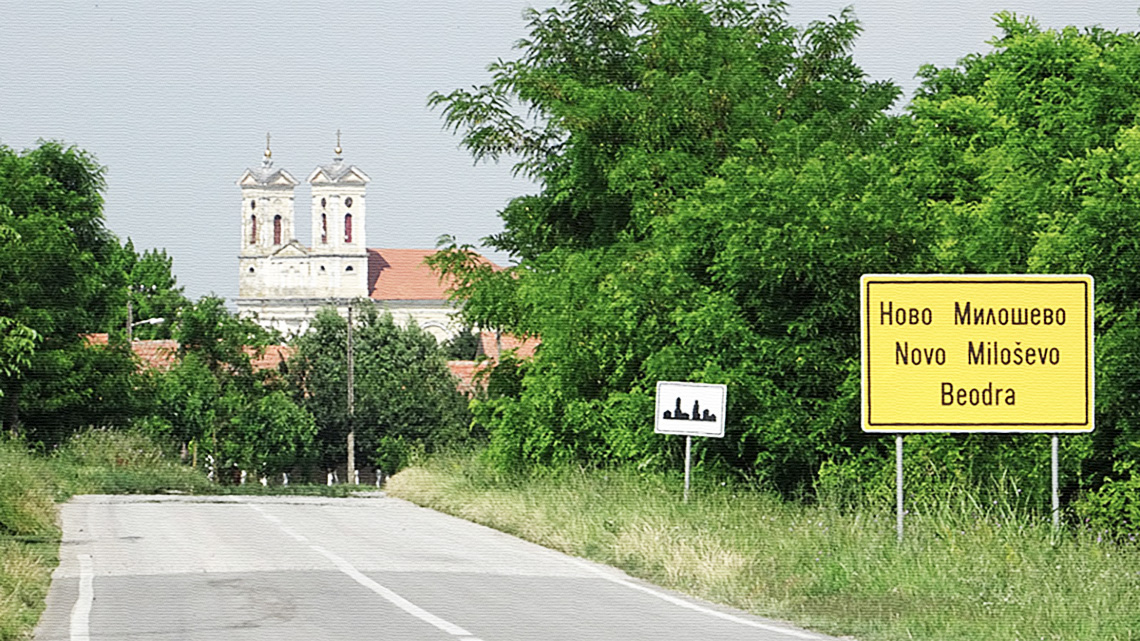
Northeast of Novi Bečej, 18 km away, lies Novo Miloševo. This village is the second largest and most populous settlement in the municipality. It is built on a loess terrace, gently sloping towards the west, towards the alluvial plain of the Tisa River.
The geographical location of the settlement is not the most favorable. Being located outside major transportation routes, it remained isolated for many years. Until the opening of the Belgrade – Zrenjanin – Kikinda railway, which was constructed near the village, this village, apart from ordinary summer roads, had no other roads. By constructing a railway from Novo Miloševo to Čoka and Senta, transportation conditions were improved once again. Thus, this settlement established railway connections with more developed settlements in northern and northwestern Banat and northeastern Bačka, and towards the south – with Zrenjanin and Belgrade. The first asphalt road was built from Novi Bečej in 1969, and then – to Kikinda in 1978. Now Novo Miloševo is connected by railway and asphalt roads to all settlements in the municipality and to the surrounding areas. Through Novi Bečej and the dam on the Tisa River, Novo Miloševo has established road connections with central and southern Bačka. All this significantly improved transportation conditions and mitigated the unfavorable geographical location.
The territory of Novo Miloševo covers an area of 174.81 km2. It stretches across the alluvial plain of the Tisa River and the Banat loess terrace. The territory has the shape of an irregular elongated geometric figure from west to east. It occupies the area from the current course of the Tisa River in the west to the Kikinda Canal in the east. The lower parts of the territory in the alluvial plain are prone to flooding, with extensive marshy areas and other degraded lands, which have significantly lower productivity compared to typical chernozem soils. The higher, well-drained parts and the loess terrace have more favorable soil composition. Along with other natural and geographical features, which have many similarities with the territories of the Novi Bečej subregion, the basic conditions for the development of agricultural activities have been established. In parallel with the development of farming and animal husbandry, increasing efforts have been made in recent years to develop industry. This economic sector is represented by a brick factory, whose production has been significantly modernized, a mill, a metalworking cooperative "3rd October," and a chemical industry facility.
History of the Settlement
Novo Miloševo was formed from two very old settlements, Beodra and Dragutinovo. It received its current name in 1946, after the celebrated fighter and organizer of the uprising in this village – Miloš Popov – Klima.
Beodra is a much older settlement than Dragutinovo and covers the southern part of Novo Miloševo. It is first mentioned in medieval documents from 1331 under the name Beldre (Boldre). In the early 14th century, the village and its surroundings became the private property of wealthy spahi families, who, over a long period, changed as owners of this area. Documents from 1461 and 1482, from the time of Matthias Corvinus, mention two settlements named Beldre. One was located north of today's Beodra and was called Beldreseg (Boldreszeg). This is today's Dragutinovo. This settlement was called Karlovo until the formation of the Kingdom of Serbs, Croats, and Slovenes. According to historical data, during the Turkish invasions of these regions, these settlements were not destroyed. It is assumed that they were saved from destruction by large and impassable swamps that surrounded the settlements at that time. However, at the beginning of the 17th century, both settlements were completely destroyed, so they are not mentioned in the census from 1717.
After the census of 1717, Serbs and Hungarians, mainly border guards persecuted by the surrounding authorities, settled in Beodra. Around 1740, a new group of Serbs and Hungarians from Akača and Kerektov settled in both places. Mass settlement of Hungarians in Beodra began in 1781, when these state-owned estates were purchased by the large landowner Karatsonyi Bogdan (Karátsony Bogdán), and from 1794 to 1805, Germans settled in Beodra.
In 1805, Beodra was granted the status of a town, with the right to hold agricultural fairs three times a year. Since then, the population has been increasing, and the settlement began to expand territorially towards former surrounding pastures and farms (Akač - a pasture, Ujtanje - a pasture, etc.). In the second half of the 19th century, significant facilities were erected in the settlement: a steam mill, a brickyard, tile production facilities, and a railway station. According to data from 1910, Beodra was a town with 754 inhabited houses and 4,600 inhabitants. Ethnically, the majority were Serbs (2,241), Hungarians (1,623), and Germans (736).
Dragutinovo (Karlovo) developed on the site of the former medieval settlement Beldreseg (Boldreszeg), which belonged to several nobles, feudal lords (the Telegdi family, etc.). It was located north of Beodra, separated only by a long-dug canal. It is characteristic that, according to historical data, this settlement disappeared during the period of the Turkish invasion. From 1740 onwards, the place was resettled by Serbs and, in honor of King Charles III, was named Karlovo. The majority of the population consisted of Serbs, border guards from southern Potisje and Arad. Although the settlement received privileges of the Kikinda district in 1774, some of the former border guards could not integrate or accept disarmament and migrated to the newly formed Danube military border. According to historical documents, 44 large families left Karlovo at that time.
During the period between 1855 and 1870, the village was flooded twice. A severe famine devastated the settlement in 1863/64, followed by a cholera epidemic that decimated the population. Despite everything, Karlovo quickly recovered and developed significantly economically. At the beginning of the 20th century, this settlement had 1,115 houses with over 5,700 inhabitants. Ethnically, the majority were Serbs (5,555) and Hungarians (180).
Population
By the total number of inhabitants, Novo Miloševo belongs to the group of the largest villages in Banat, and even in Vojvodina. According to the 1921 census data, this village had 9,850 inhabitants. At the end of World War II, German families emigrated, and then, through colonization, the population was replenished by immigrants from our impoverished and war-torn regions. According to the 1948 census, Novo Miloševo had 9,536 inhabitants, which is approximately the same as 27 years before. The period from 1961 to 1981 indicates a gradual decline in the total number of inhabitants in this settlement. In 1961, the village had 9,276 inhabitants, in 1971 - 8,552 inhabitants, and in the last census in 1981 - 7,801 inhabitants. The causes of the decline in the total number of inhabitants are very similar to those in other settlements. They can be attributed to constant migration to cities and more developed economic centers, as the village, with its modest and monotonous economy, cannot provide adequate livelihoods for all young people. Furthermore, the decreasing natural growth rate questions the normal natural reproduction of the population.
In terms of gender, age, and other demographic structures, similar characteristics are observed as in other municipalities. The gender ratio is naturally balanced. There is an increasing representation of older population groups in the age structure, a phenomenon characteristic of most villages in Vojvodina. In terms of ethnicity, Serbs are the most represented, with 5,848 according to the last census in 1981. They are followed by Hungarians (1,613), Roma (345), and the remaining 995 inhabitants belong to other nationalities and ethnic groups. The population structure according to educational attainment also indicates certain similarities with other settlements in the municipality. In 1981, among residents aged 15 and older, 388 individuals had no formal education, and 2,431 had completed from one to seven grades of elementary school or did not have a complete primary education. There were 2,174 individuals with completed primary education, and 1,050 with secondary education. Higher education was attained by 83 individuals, and 39 had a college or higher education. Considering that individuals without formal education and with incomplete primary education mostly belong to older age groups, this structure of the population by educational attainment can be considered satisfactory.
Like other places in the municipality, Novo Miloševo is a typical Pannonian settlement. It has a rectangular shape with straight and wide streets. The settlement has a length of about 5 km along its longer axis, running northeast to southwest. There are several longitudinal streets and three times more transverse streets. The main street is about 50 meters wide. The houses are of Pannonian type, with the same characteristics as in other inhabited places in the municipality.
In terms of communal organization and aesthetic appearance, Novo Miloševo occupies a leading position among other villages in the municipality. All streets are green, with planted avenues, landscaped lawns, and flowerbeds. Most streets are paved, and over 60 km of sidewalks have been concreted and arranged alongside the houses. The center of the settlement is exceptionally well-kept. Six monuments to the fallen in World War II have been erected, and 18 memorial plaques have been installed.
The settlement has a water supply system, a stadium with stands and other sports facilities, a cooperative and youth center, a cinema, and a new, modernly equipped health center. The most important educational institutions are: preschool institution (kindergarten), elementary school "Miloš Popov - Klima," branches of the vocational education school, and a library. The elementary school is the pride of Novo Miloševo. It is modernly equipped and achieves remarkable results in educational work. Special attention is paid to educational work and nurturing the traditions of the National Liberation Struggle, manifested in free activities, public appearances, and literary works of the students.
In the initial development of the communal system, Novo Miloševo was a separate municipality, which included the settlement of Bočar for a short time. Since 1960, it has been part of the municipality of Novi Bečej. The settlement has a single local community and local office, as an outpost organizational unit of the municipal administration.
In its rich history, Novo Miloševo experienced its brightest moments during the People's Liberation Struggle. A large number of residents participated in this struggle and collaborated with the movement. A prominent fighter and organizer of the uprising in the village was Miloš Popov - Klima, after whom the settlement Novo Miloševo was named. Among other notable figures of this settlement are Dr. Đorđe Joanović, founder of the Faculty of Medicine in Belgrade, and Teodor Pavlović, a renewer of Matica srpska.


Comments