



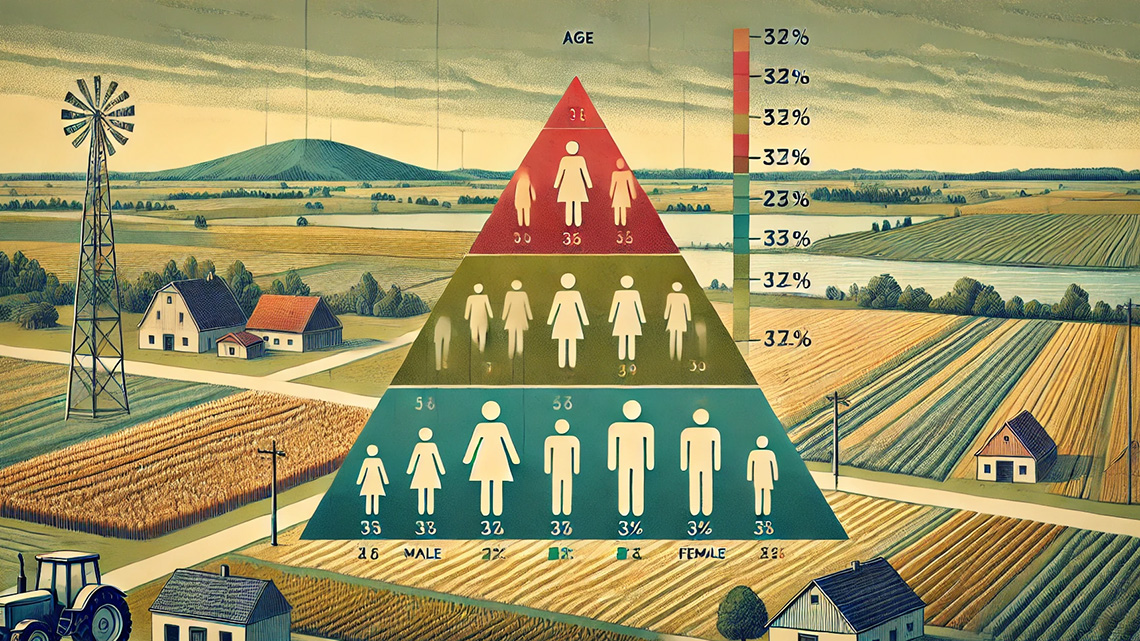
Due to the incomplete processing of data from the 1981 population census, a more detailed analysis of the gender and age structure of the population of the municipality of Novi Bečej can only be based on the results of earlier census years. According to the 1961 population census, out of a total of 33,507 residents, 16,965 or 50.60% were female.
The proportional ratio between male and female population in this census year was quite good. When analyzing the population by year of birth and gender from 1951 to 1961, it is observed that more female than male children were born only in 1958 and 1961, while in all other census years during the observed period, masculinity was higher.
In the 1971 census year, the difference between the total number of male and female population is slightly more pronounced. Out of a total of 31,729 residents, 16,187 were female, accounting for 51.01%. When analyzing the population of the municipality by year of birth and gender from 1961 to 1971, a higher representation of the female population is noticed in several census years: 1961, 1963, 1965, 1969, 1970, and 1971.
A more detailed analysis of the population by year of birth and gender within the municipality, by settlements, reveals similar characteristics. In no settlement, during the observed twenty-year period, were there extreme cases where the number of female and male population visibly differed, either positively or negatively, over a longer period. Individual deviations occurred in certain years, but they did not significantly affect the gender structure of the settlements and the municipality as a whole over a decade. For example, in Bočar, in 1958, 10 residents of female gender were born compared to 20 males, or in 1970, in the same settlement, 13 residents of female gender were born compared to 26 males. However, in the overall gender structure of this settlement from 1951 to 1971, such indicators were almost negligible. Out of a total of 2,328 born individuals in the mentioned twenty-year period, the female population was represented by 1,145 individuals, and the male population by 1,183 individuals, with only 38 more males.
The age structure of the population indicates certain specificities and tendencies. Already within the natural population increase, it is emphasized that the Novi Bečej subregion has an increasing share of older population in the age structure, while the representation of the youngest population gradually decreases.
Among the age groups, the largest indices of decline are recorded from 0 to 9 years of age, from 10 to 14, and from 25 to 34 years of age. The greater decline in the first two age groups is caused by a multi-year decline in natality in the municipality. However, the lowest index (69.04) in the age group from 25 to 34 years is a consequence of the long-standing process of young people emigrating to larger and more developed economic centers. The relatively high contingent of the population in the age group from 15 to 19 years is very significant for the municipality, as the workforce is expected from this age group. If we add the approximately satisfactory index of the age group from 20 to 24 years, then significant natural possibilities of the municipality to provide a young workforce from its own territory are noticed. However, the insufficient economic development of the municipality, with still very modest industrial capacities, is not able to absorb all the capable workforce in a timely manner, which, in the older age group, flows into other economic areas of Vojvodina.
For the two mentioned census years, there is a noticeable data indicating a relatively high representation of the older population in the Novi Bečej subregion. The largest increase in indices is achieved in the age group of 65 and over. This population is partly outside the working contingent and supports an insufficiently high contingent of active population. The largest percentage of the population in this age group belongs to so-called elderly households in agriculture, which significantly reduces the possibilities of intensifying agricultural production.
Data from the 1971 census more precisely indicate the gender and age structure of the population of the Novi Bečej subregion. The population distributed into 16 age groups shows very different characteristics and tendencies of increase or decrease.
In the analysis of individual age categories of the population, it is noted that there is a lower representation of the youngest population in the age structure of the municipality, followed by age groups from 25 to 29 years and 50 to 54 years. The categories of the child age group from 0 to 4 years and 5 to 9 years, compared to the total population, are represented by 5.93% and 7.00%, respectively. These youngest residents of the municipality were born between 1961 and 1971 and are expected to form the basis of the working population. Most of them opt for further education and studies, after which only a small percentage returns to their place of birth or to the territory of the Novi Bečej subregion.
The sixth age group is even smaller than the previous ones. In this group from 25 to 29 years of age, the population is most capable of work. From this age category, almost the largest outflow of population to other economically more active areas occurs. This age category is represented by only 3.15% of the total number of residents in the municipality.
A noticeably small number of residents, compared to age groups under 65 years of age, belong to the age category from 50 to 54 years. It has only 1,399 residents, or 4.4% of the total population of the municipality. The decisive influence on this deviation was the Second World War. Namely, this is a consequence of the war in which a higher percentage of the population from this age group lost their lives.
The largest number of individuals belongs to the age group from 15 to 19 years. In relation to the total population, this group makes up 8.45%. Individuals from this age category were born between 1952 and 1956 when the natural development of the municipality's population was characterized by increased natural increase.
Age groups from 35 to 39 years (7.46%) and from 40 to 44 years (7.69%) have a higher representation compared to other age groups.
If the age groups of the population over 60 years of age (the population whose working life is ending) were combined, the largest age group of residents in the entire age structure would be obtained. This is the old and oldest population of the municipality. This age group had 5,758 individuals in 1971, and its representation in the total population of the Novi Bečej subregion was 18.14%.
From the perspective of further economic development of the municipality, the working potential of the population is very important. Viewed through the biological type of the population, according to the census from 1961 and 1971, the working potential of the population has a specific structure and shows certain tendencies. Usually, this population group accounts for about 50% of the total number, so such movements in the municipality can be considered positive. If the values for 1971 in Table 25 between the first and third age groups were reversed, i.e., if there was a greater representation of younger and a smaller representation of older population, the natural type of the population of the municipality, from the perspective of ensuring the working potential of the population, would be quite satisfactory.

Comments