



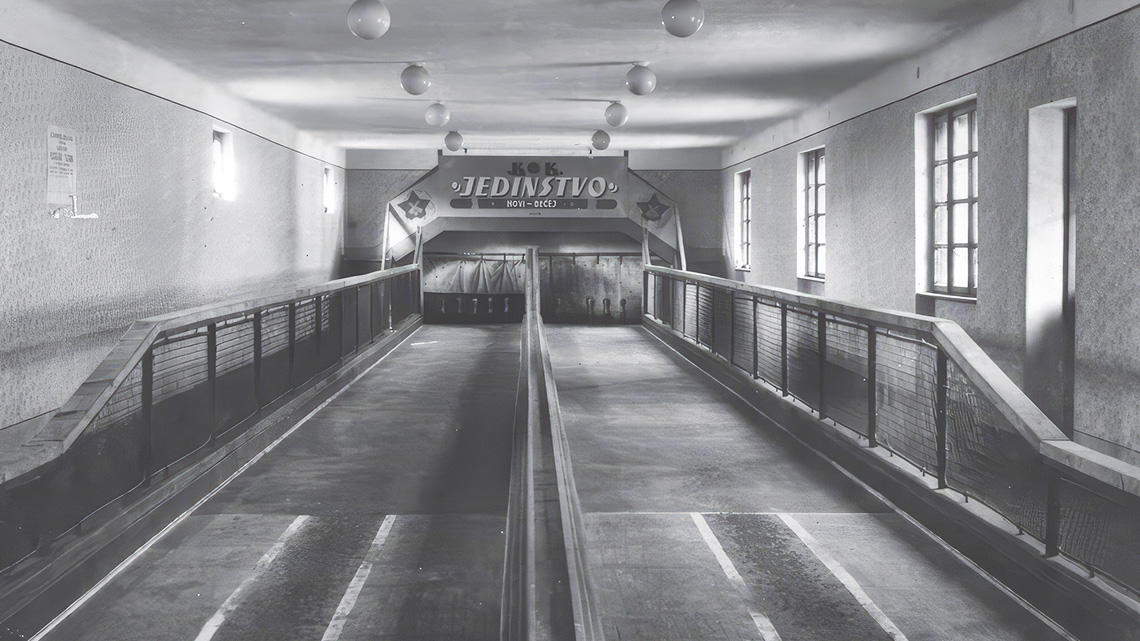
The numerous bowling alleys in Novi Bečej’s cafes confirm that this sport was a beloved pastime for the residents of the town on the Tisa. The oldest alley in the area is certainly the one at the “Sokolac” mansion near Novi Bečej, built in the 19th century. This single-lane bowling alley (shown in the picture) could still be functional today with minor adaptations and could serve as an interesting tourist attraction. The existence of a bowling alley in the mansion confirms that bowling was a favorite game of the aristocracy.
Restaurant owners recognized that bowling attracted customers and increased their business, so bowling alleys were usually built adjacent to or within the establishment, often with a dirt or occasionally wooden surface. The alleys typically had nine pins, though some only had three. Games were often played for drinks, which naturally suited the café owners.
Before and after World War II, Novi Bečej had numerous single-lane wooden bowling alleys in cafes such as “Balkan,” “Sič,” Arsen Pecarski’s in Vranjevo, “Eđšeg,” the Firehouse, and the Youth Center in Šušanj, among others.
 The most popular bowling alley was in the “Laslo” cafe in Novi Bečej (at the corner of Narodni Front and Sonja Marinković Streets), where official bowling matches were held after the war until the end of 1950 when a new bowling alley was opened.
With the increasing popularity of bowling, the need for a modern bowling alley in Novi Bečej arose. Construction of a new alley by the “Zvezda” Union Sports Society began in 1949 at the site of the current Pensioners’ Home on Marshal Tito Street 19.
In early 1949, three cubic meters of oak planks were purchased, along with 1,500 kg of lime and 3,500 machine bricks in April. Masonry work was assigned to contractor István Šimon, who engaged several workers, including Ferenc Kormoš, Šandor Fabian, István Bartus, Maćaš Šimon, Juliška Kosoruš, and Mladen Bojić.
The metal brackets for constructing the alley were made by blacksmith Petar Nelovankovits, while carpentry was done by master carpenter István Kovač and his team. Carpentry work was completed on September 15, 1949, when the alley was roofed. On January 27, 1950, a 10,000 dinar advance was paid to electrician Józef Andre for materials and electrical work, indicating that the project was nearing completion at the start of 1950.
Costs exceeded expectations, so the bowlers organized events and dances to raise funds. In a letter dated January 27, 1950, the “Zvezda” Union Sports Society's Bowling Section from Vološinovo requested permission from the Bečej County People's Committee (Education Commission) in Zrenjanin to hold a dance on January 29, 1950, at their sports hall on Marshal Tito Street 17. The income was solely for building the sports bowling alley, scheduled for completion by early April. The letter was signed by well-known local merchant Slobodan Rakić.
The Bečej County People's Committee approved the event in a letter dated January 2, 1950, on the condition that the proceeds would support the construction of the physical culture facility.
Although the alley was expected to be completed by the end of April, the work slightly delayed. Asphalting was done in May 1950 by contractor Toma Vojković from Zagreb, who received an additional 1,500 dinars for his workers’ overtime on May 24, 1950.
On August 1, 1950, the “Pobeda” Footwear Cooperative from Novi Bečej invoiced rubber mats worth 9,142 dinars. Electrician Józef Andre completed the electrical work on September 14, 1950, marking the completion of the modern two-lane alley with asphalt lanes.
Over time, the wooden backing behind the pins suffered considerable damage from ball impacts. To absorb the impact, the club ordered a large leather cushion from the “Kožarac” Leather Goods Cooperative in Novi Bečej on August 21, 1951, paying 3,055 dinars.
Simultaneously, a basketball court with an asphalt surface was built, forming a mini sports complex.
The new alley, with a small bar, was a favorite and highly frequented venue, especially in winter, for a full 25 years until the automatic bowling alley was built in 1976.
Comments