



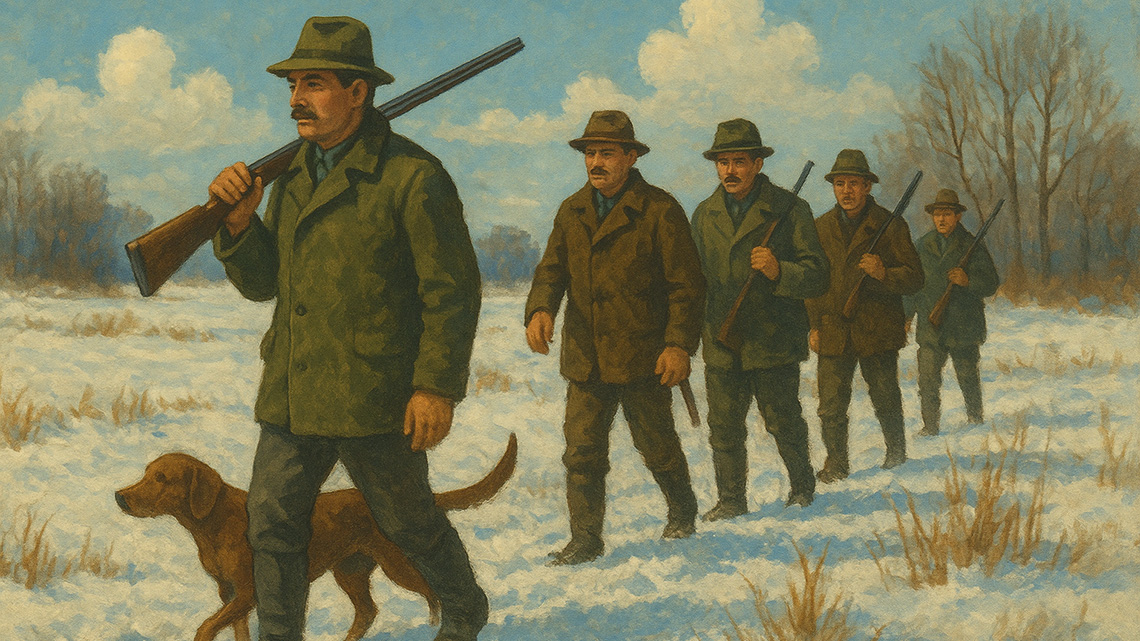
Based on extensive archival materials about the history of the Hunting Society of Novi Bečej — discovered in various archives and hunting journals (Lovački glasnik 1922–1941, Vojvođanski lovac 1946–1961, Lovačke novine 1962–2011), as well as in the Monograph of the Hunting Association of Vojvodina published in 1992 to mark the 70th anniversary of the Association — a large collection of records, photographs, hunting plans, management reports, fraternity charters, hunting maps, sketches, and other documentation was gathered.
Supplemented by the testimonies and recollections of veteran hunters, as well as meeting minutes from boards and assemblies, this archival work has refreshed the memory of one of the oldest hunting societies in this region.
This text presents original excerpts — authentic reports and news published in hunting press and other archival sources. To preserve the originality and accuracy of historical facts, the material is given in its original form, aiming to portray the period in which the society was founded, how it managed its game, the challenges it faced, the results it achieved, and its transformation through numerous hunting laws over more than 120 years of existence and activity.
1924
- Lovački glasnik, issue no. 3 (March 15, 1924), published data on the closed season for game.
In Vojvodina, the hunting ban for partridges lasted from January 1 to August 1 (in Serbia until July 15, and in Croatia until August 15). The ban for hares started on February 1 and lasted until August 25 (in Serbia until July 25, and in Croatia until August 1, or until August 15 in vineyard regions).
When winters were mild and short, the first young hares could be seen in March, and by July or August they would already produce new offspring. However, in 1924 it was expected that the harsh winter would destroy the first litter, so it was recommended that all hunting societies extend the closed season until October 1 (Lovački glasnik, no. 3, 1924). - Pheasants were under protection from February 1 to August 15 (in Serbia until July 25, and in Croatia until September 1). As this is a tame and attractive game species, its population remained small due to the lack of suitable habitats and numerous natural enemies (Lovački glasnik, no. 3, 1924).
- According to the report of the District Chief of Novi Bečej, published on March 15, 1924 (p. 20):
- In Vranjevo, 5 drives were organized: the first yielded 260 hares, the second 240, the third 360, the fourth 524, and the fifth 192 — a total of 1,582 hares.
- In the Novi Bečej hunting grounds, 4 drives were held: 80, 170, 70, and 156 hares, totaling 476 hares (Lovački glasnik, March 15, 1924).
1925
- In Lovački glasnik, October 1925 (pp. 146–147), under News from the Federal Administration, the list of registered hunting societies for the 1924/25 hunting season includes the Federal Hunting Society of Novi Bečej, with 45 members.
The data were taken from the report of Mr. Joca Divild, the first secretary of the Association, presented at the 3rd regular general assembly in Subotica on August 23, 1925. - The President of the Federal Hunting Society of Novi Bečej in 1925 was Svetozar Veselinov (Lovački glasnik, June 1925, p. 68).
1926
The Federal Hunting Society of Novi Bečej managed a hunting area covering 13,100 cadastral acres.
That year, 456 pests were killed, the highest number by Aleksandar Bartovski (43), and 253 useful game animals, including 163 hares (Lovački glasnik, Jan–Feb 1926, p. 31; Monograph of the Hunting Association of Vojvodina, p. 87).
1927
The Federal Hunting Society of Vranjevo organized a very successful hunting drive on January 3, 1927. In four rounds, 824 hares were taken (Lovački glasnik, January 1927, p. 14; Monograph of the Hunting Association of Vojvodina, p. 87).
Comments