



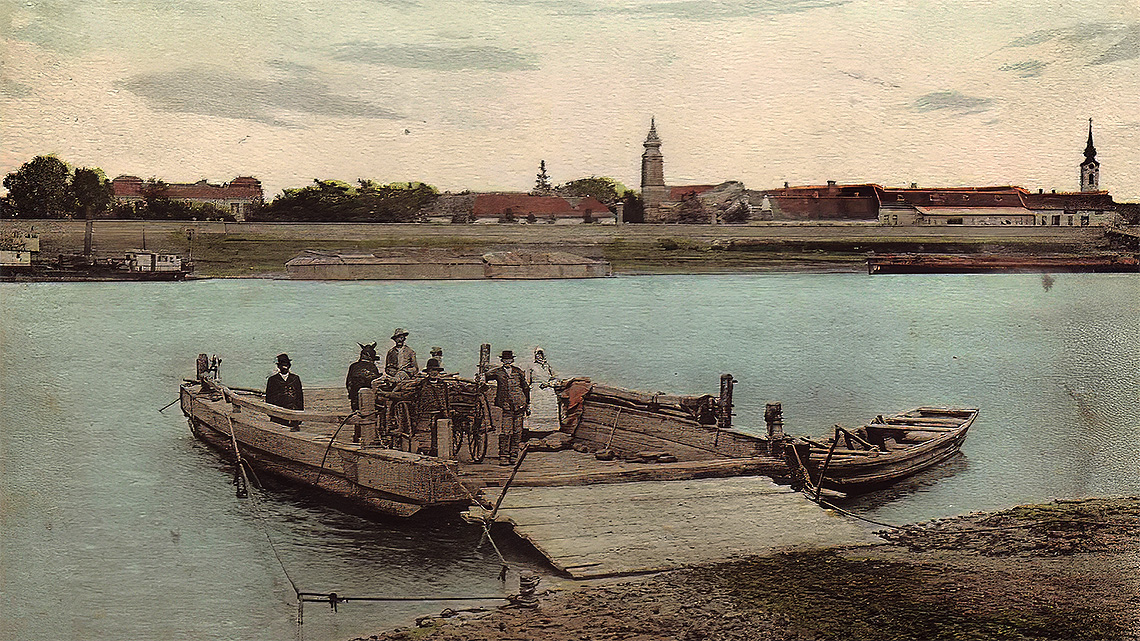
The inhabitants of Vranjevo and Novi Bečej utilized the benefits of the Tisa River not only for economic purposes but also for recreation and sports, especially during the summer months.
Regarding economic aspects, the construction and operation of the port were of great significance for the economic development of Novi Bečej. The port on the Tisa was one of the most important in the Kingdom of Yugoslavia, both for the transport of grain and for passenger traffic. The significance of grain transport and storage is evidenced by the Grain Warehouse, located next to the Tisa, built between 1778 and 1780, which was declared a cultural monument by the Government of the Republic of Serbia in 2001, as a technical culture site and a testament to the historical method of grain storage.
River passenger traffic was also highly developed, particularly towards Bačka (Stari Bečej). In addition to the ferry, which primarily served to transport horse-drawn carts to the very fertile fields of Pearl Island, it also served as an important link between Banat and Bačka. Shipping traffic with boats was very developed. A small boat operated daily between Novi Bečej and Stari Bečej, while a larger vessel made daily trips from Titel to Szeged and back, stopping at the Novi Bečej port.
Novi Bečej was a significant center for grain transport and river passenger traffic. In his book “Novi Bečej and Vranjevo Through History from the Earliest Times to 1941,” Lazar Mečkić confirms this on page 209:
According to statistical data from the Kingdom of Yugoslavia for the year 1929, a total of 21,252 tons were dispatched from the Novi Bečej port, 16,375 from Titel, 13,772 from Senta, and 10,324 tons from Novi Kneževac. That year, the Novi Bečej port ranked high in passenger traffic. A total of 28,931 people passed through the port in Stari Bečej, 28,380 in Novi Bečej, 11,096 in Titel, and 2,192 in Senta.
During the summer months, the Tisa was the main gathering place for the youth of Novi Bečej. There were exceptionally favorable conditions for this, as there was a large floating bath on the left bank of the Tisa River.
In the book “Greetings from Novi Bečej – Üdvözlet Törökbecséről” (Mr. Aleksandar Kasaš and Karolj Andre, published by the Public Library of Novi Bečej, 1994), a photograph of the bath and the following text is published: “Between the two world wars, the people of Novi Bečej had a proper floating bath with floating pools, private cabins, and a sunbathing platform. During the bathing season, Novi Bečej residents could rent boats at the bath owned by the popular Roža. Cold drinks and sandwiches were always available there.”
About the exceptionally beautiful and large floating bath, Lazar Mečkić writes in his book “Novi Bečej and Vranjevo Through History from the Earliest Times to 1941,” on page 334: “Alongside all the natural amenities for swimming and sunbathing, Novi Bečej had a beautiful and large floating bath on the Tisa at the end of the nineteenth century, continuing until World War II. No other location, such as Stari Bečej or Veliki Bečkerek, had such a facility in terms of size and appearance. It was one of the most beautiful on the Tisa, possibly even throughout Hungary. Szeged had more smaller floating baths, but the Novi Bečej one was really large with two flowing pools: one for men and one for women, and a smaller one for children.”
Considering such advantages provided by the Tisa River to Novi Bečej, as well as its economic potential, it is entirely understandable that ideal conditions existed for the development of swimming and water polo as organized sports disciplines.
Footnotes:
- Lazar Mečkić: “Novi Bečej and Vranjevo Through History from the Earliest Times to 1941,” Workers’ Home “Jovan Veselinov Žarko” 1989, p. 209.
- Mr. Aleksandar Kasaš and Karolj Andre: “Greetings from Novi Bečej - Üdvözlet Törökbecséről,” Public Library of Novi Bečej 1994, p. 44, photo p. 45.
Comments