



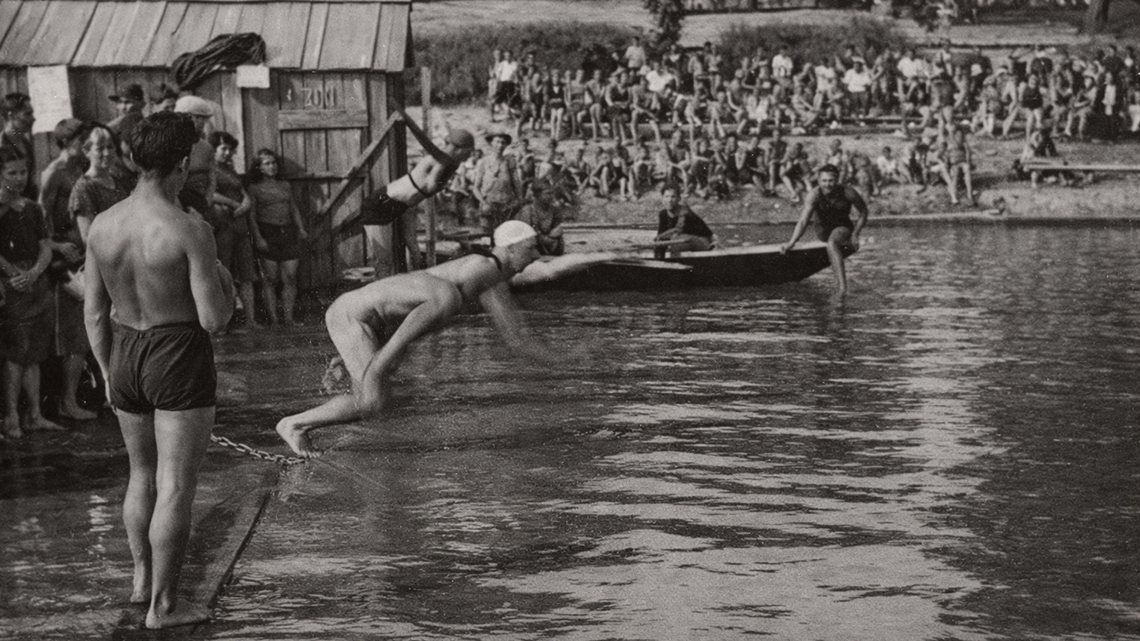
After notable activity in 1945 and 1946, and five years of quiet, swimmers and water polo players from Novi Bečej returned to the scene in 1951. That year, 19 active swimming organizations were recorded in Vojvodina, including the Novi Bečej club, which operated within the Vranjevo Sports Society Zvezda.
On July 1, 1951, Novi Bečej swimmers took part in the open championship of neighboring Bečej. Participants included swimmers from the host club BSK, Polet from Sombor, Senta, Spartak from Subotica, Zvezda from Vološinovo (the name of Novi Bečej until 1952), and Jedinstvo from Bačko Petrovo Selo. The final team standings were as follows: Polet (Sombor) 76 points, BSK (Bečej) 34, Senta 34, Spartak (Subotica) 9, Zvezda (Vološinovo) 4, and Jedinstvo (Bačko Petrovo Selo) without points. (“Sl. Vojvodina”, No. 2059, July 2, 1951)
During 1951, at the level of the Zrenjanin district, the Swimming Sub-Association of Zrenjanin was established, headed by the very active sports worker Dušan Grubić. That same year, he initiated the formation of swimming and water polo clubs in Banat and their competition within the sub-association league. Instructors from Zrenjanin visited various settlements to organize sports sections together with local representatives and to engage professionals or enthusiasts willing to work on developing swimming and water polo.
Sections were thus formed within sports societies or as independent clubs: Radnički (Kovin), Proleter II (Zrenjanin), Dinamo (Pančevo), Polet (Novi Bečej), Kristal (Zrenjanin), and Radnički (Kikinda). These clubs would begin organized competitions the following year, 1952. According to the recollection of swimming instructor Stevan Rankov from Zrenjanin, attempts were made to form swimming sections in Novi Kneževac, Banatski Despotovac, and Klek, but without success.
The Radnički Swimming Club from Kikinda was formed in 1951 but had no opponents for competition, since PVK Proleter from Zrenjanin was in a higher division, while other clubs had not yet been formed or were not financially and organizationally capable of participating in competitions.
A fortunate circumstance for Novi Bečej’s PVK Polet was that Radomir Ivanić, a versatile athlete, completed a one-year training program in Zemun to become a certified physical education instructor and obtained a job at the elementary school, where he took on the role of swimming coach.
With his engagement, and with the help of the “old guard” of swimmers Aleksandar Marčić, Vladimir Kiselički, Zvonko Tolmačev, Branislav Vojnov, Milivoj Marić, Sava Ivanić, as well as financial support from the municipality and the Polet Brick and Tile Industry, the first floating swimming facility on the Tisa was built in 1951. It was located at the former docking site, upstream from the stone city swimming area “Kamenjara,” later known as the “Main Beach.”
The swimming facility consisted of two floating pontoons (timber and planks mounted on metal barrels), measuring 5×12 m and 3×12 m, anchored and secured with steel cables along the bank of the Tisa. Both pontoons had lowered wooden turning boards into the river current, one meter deep, which mostly slowed the current (much more effectively near the shore than in the outer lane toward mid-river). On the first upstream pontoon there was a wooden cabin that served as a changing room and storage for equipment.
Comments