



Although a new occupying authority had been established, PSK Tisa continued to operate under difficult circumstances. In his diary “Let Us Tell You,” Branislav Kiselički writes:
The April catastrophe struck too unexpectedly. Everything suddenly fell silent. We were awakened by an order to officially disband. Materially, we were degraded: our seal, archives, and 1,800 dinars were confiscated. Yet, our enthusiasm for sports remained. We started the season "by the pump" in mid-May. Things went on like this until the “ban,” which brought our swimmers “tantalizing torment.” To make matters worse, the weather turned warm, and our poor swimmers still maintained their fitness like this (see the sketch below).
The lifting of the ban brought relief to everyone. We no longer had a permanent location and wandered from one beach to another until we finally settled at the Gradište beach. Here, we came to life again.
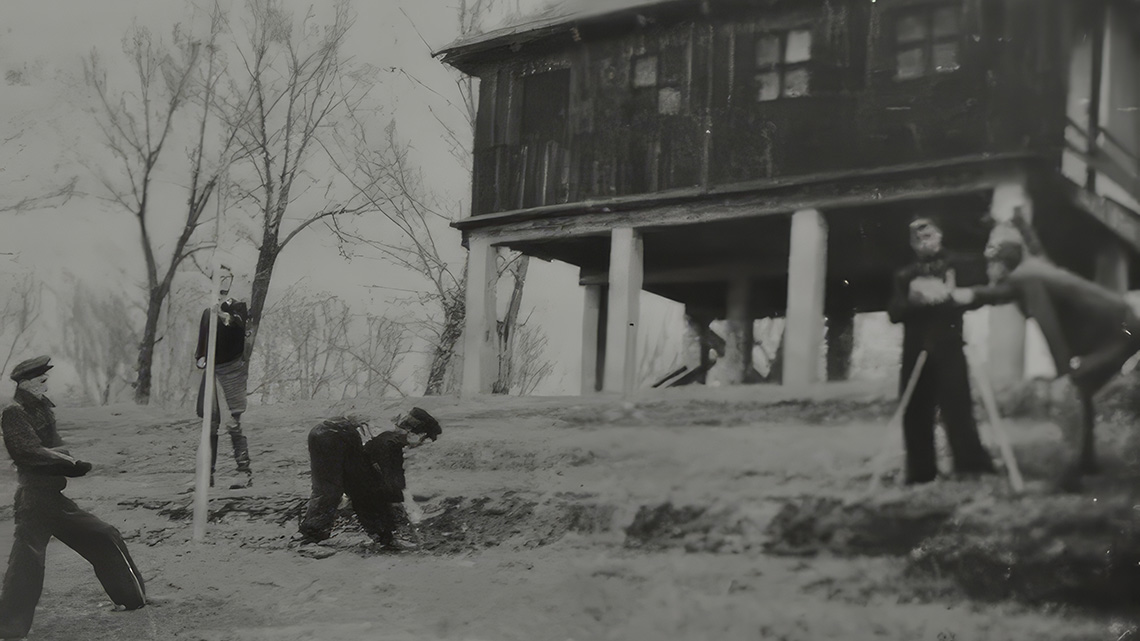
The club’s president, Rada Aćimov, suggested to the swimmers that the sports club house and its surroundings be organized to create a proper space for themselves. The members of PSK Tisa embraced the idea and began voluntary work from July 28 to August 3, 1941, to renovate their club house. Branislav Kiselički recounts in his diary:
We started early on Monday morning, July 28. Shovels, spades, axes, carts, sand-carrying stretchers, excellent moods, and good weather all combined into a beautiful picture of youth and effort. Thanks to outstanding leadership, camaraderie, discipline, and everyone’s goodwill, the work progressed quickly, and good spirits stayed with us until the end. Shovels worked in unison, tossing wet sand into piles and spreading it further; axes gleamed in diligent hands; and our young "freestyler" groaned while pushing a wheelbarrow whose wheel sank deep into the sand. We leveled, arranged, and whitewashed as the “engineer” busily darted around the site, shovel in hand, fixing and smoothing everything, while “Ace No. 1” strutted around the grounds with dignity, calling out slackers (as if he wasn’t one of them).
The ladies—or rather, one lady, as only one managed to endure from start to finish—worked hard arranging the “club rooms,” which gradually began to look like spaces inhabited by humans. The work advanced, muscles grew tired, yet morale and discipline held strong. People watched us, genuinely sympathized, and joined in—different genders and ages, but all young and enthusiastic. We started with about 10 people and ended with 30. Once everything was organized and tidied up, we began moving in our belongings: the old water polo field, a storage chest, first-aid supplies, sports equipment, a chess table, volleyball poles, and so on (we banned cards and smoking). Finally, we were ready to enjoy ourselves.
However, the Tisa swimmers didn’t bask in their “little house” for long. The new occupying authority soon issued a prohibition on any sports gatherings for young people. As a result, PSK Tisa was officially banned on August 17, 1941 (as recorded by Branislav Kiselički). Since there was money in the club’s treasury from membership fees, club secretary Branislav Kiselički meticulously noted in the treasury journal that the membership fees were refunded to individuals, and the treasury balance was reduced to zero by September 8, 1941.


Comments